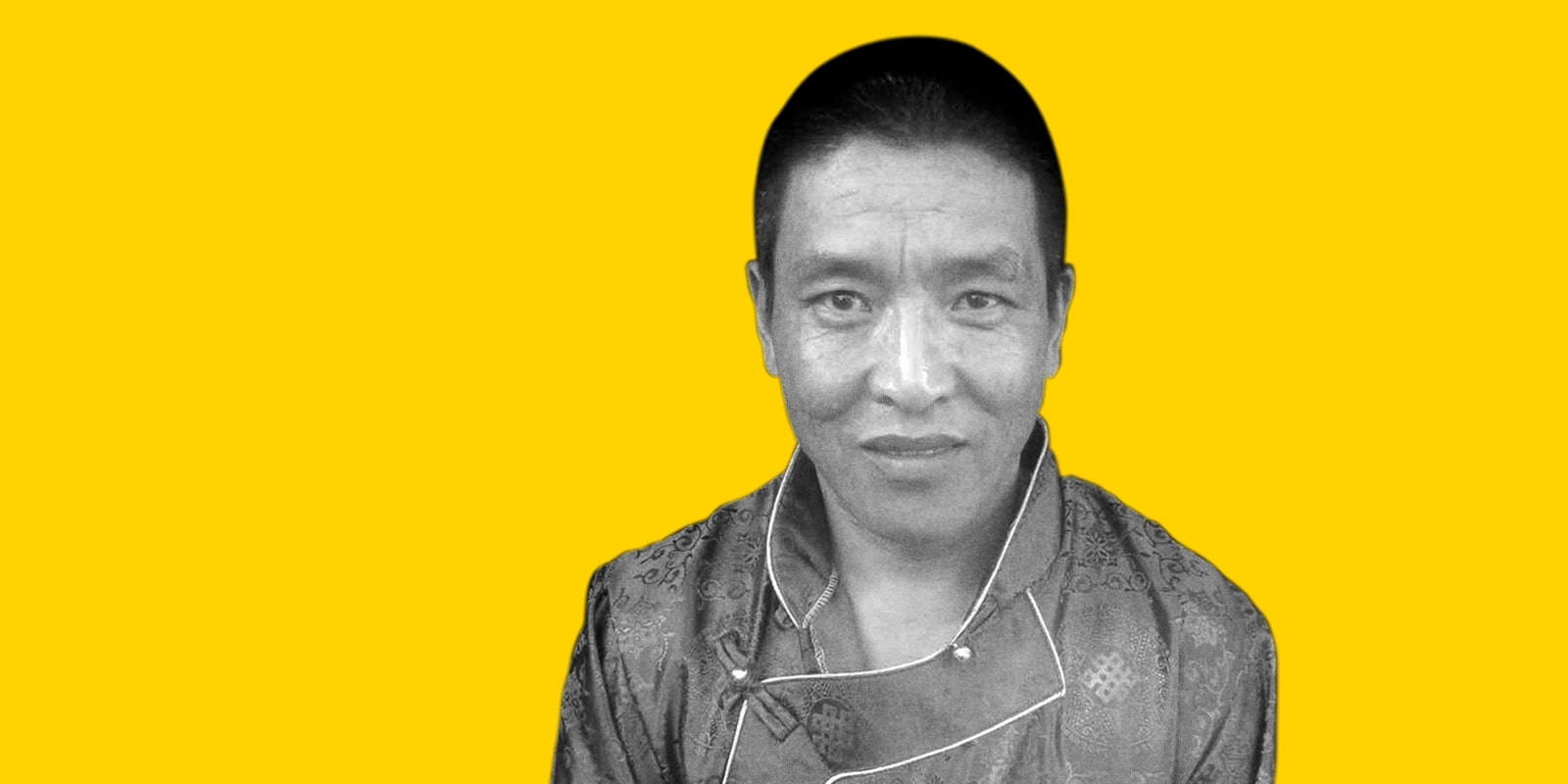
DHONDUP WANGCHEN: ESCAPED INTO EXILE!
 “After many years, this is the first time I’m enjoying the feeling of safety and freedom. I would like to thank everyone who made it possible for me to hold my wife and children in my arms again. However, I also feel the pain of having left behind my country, Tibet.”
Detained by Chinese authorities in Tibet in March 2008 for making the documentary film Leaving Fear Behind, Dhondup Wangchen was sentenced to six years in prison for “inciting subversion”.
Dhondup Wangchen’s arrest and imprisonment sparked one of the most intensive campaigns for a Tibetan activist. He contracted Hepatitis B in prison and was made to undergo manual labour. Even though he was released from a prison in Qinghai’s provincial capital Xining on June 5, 2014, he remained under strict surveillance with his movements and communications constantly monitored. Dhondup Wangchen was able to successfully evade the authorities and flee from his home area in Tibet and then the People’s Republic of China altogether. Read in full at Filming For Tibet
Dhondup Wangchen’s film, Leaving Fear Behind was made using a series of interviews with ordinary Tibetans on their views on the Olympic Games, the Dalai  Lama and Chinese government policies in Tibet; the film gives the viewer a rare glimpse into the reality of Tibetans living under Chinese occupation.
Dhondup Wangchen was born on 17 October 1974 in Bayen in the Tsoshar region of Amdo, the northeastern province of Tibet. Born into a farming family, Dhondup received no formal education and as a young man, he moved to Lhasa where he became aware of the grave threats faced by the Tibetan people. In 1993, Dhondup, along with his cousin Gyaljong Tsultrin, made the arduous journey out of Tibet to India, traveling on foot over 5,000 meter passes to receive a teaching by the Dalai Lama. Soon thereafter both returned to Tibet further motivated to work for the benefit of the Tibetan people but in 2002, Tsetrin was forced to flee Tibet and received political asylum in Switzerland.
In 2007 the two cousins began to work in collaboration on the film Leaving Fear Behind, with Dhondup in Tibet and Gyaljong in Switzerland. Dhondup, with the help of his friend Jigme Gyatso, set out with extraordinary courage to film Tibetans in Tibet describe in their own words their views and feelings about the Dalai Lama, the Beijing Olympic Games and Chinese laws in Tibet.
They traveled thousands of miles and overcame innumerable hurdles, determined to bring the unheard voices of the Tibetan people to the world stage. The resulting interviews are a remarkable portrayal of ordinary Tibetans and their stories of hardship and courage that gives a rare glimpse of the thoughts, feelings, and struggles of Tibetans living under occupation.
In Dhondup Wangchen’s own words: “At a time of great difficulty and a feeling of helplessness, [the idea of our film is to] get some meaningful response and results. It is very difficult [for Tibetans] to go to Beijing and speak out there. So that is why we decided to show the real feelings of Tibetans inside Tibet through this film.”